Hey there, long time no chat!
Can I really even call this a chat though? Let’s be honest, it’s one-way communication where I write and you read. I like it that way.
If you’ve been looking around, you have probably been wondering: where’s he been for the last two months? That’s a logical question to ask after posting on a regular cadence for a few weeks.
I’ve been busy. As the world continues to change and evolve, AI is morphing the way we work. I’ve been consuming content, building new tools, enhancing older ones, and trying to build out solutions that people can use to enrich their lives.
The whole point of product building is to enrich people’s lives so they don’t have to struggle in the same ways we once did. All of the greatest ideas from normal builders (don’t think about Steve Jobs or Jeff Bezos here, they aren’t the norm) come from situations where a real need arises and you’re just tired of the status quo.
As you’ve probably noticed with my RAW Recaps, I enjoy WWE. As a middle-aged man, I grew up during the Golden era, came of age during the Attitude/NWO era, and have watched the business evolve in a multitude of ways.
Recently, I’ve figured out a paradigm shift that’s taken place in WWE since its acquisition by TKO and I really believe this application applies across all entertainment and sports.
Historically, sports have used embargo windows. Content that ran on network TV or through other major players in the live sports space was forced to be held for 48 hours to encourage live viewership.
What I’ve been noticing from WWE, though, is that they are creating micro-content and posting it on YouTube within an hour or less of the conclusion of their live events. This micro-content gets hundreds of thousands to millions of views, and ads run in the middle of all of it.
From a monetization perspective, it’s genius. The core idea is simple and has been done this way for years: Produce the live event for the live audience, but take that content and immediately create highlights from it. In the modern world, people are more apt to spend time watching 30 minutes of highlights and produced clips with ads than they are watching two hours of content and sitting through traditional commercial breaks. If they don’t want to watch the ads on YouTube, they’ll just upgrade to premium and watch anyway.
From a traditional fan perspective it might feel off, but from a business perspective, it is incredibly effective.
Saturday Night’s Main Event is a perfect example. The live event ran on Saturday, May 23 from 8 PM - 10 PM Eastern time on NBC and Peacock. It was broadcast from an event in Fort Wayne, Indiana in front of 11,000 screaming fans.
Those fans are your core audience. They will mostly always be there. But we learned during COVID that sports and entertainment could be played in front of empty venues and people would still desperately want to consume the content.
Estimates of viewership on NBC/Peacock since the event returned in December 2024 have been between 1.5 and 2.3 million viewers (USTVDB). Let’s call it an average of 2 million.
The most recent event over Memorial Day Weekend will most likely not hit that peak, as baseball alongside the NBA and NHL playoffs will cut into that audience significantly. Not to mention, typical viewership drops during holiday weekends.
Regardless, less than 12 hours after the conclusion of the live event, there are six clips and one full-highlight package on the official WWE YouTube channel (which boasts 113 million subscribers).
Below is a breakdown of that viewership as of 9:20 AM ET on Sunday, May 24:
- Full Highlights: 215,000 views
- Main Event Clip: 126,000 views
- Main Event Aftermath Clip: 123,000 views
- Women’s Tag Team Clip: 138,000 views
- Intercontinental Championship Match Clip: 101,000 views
- Six-Women Tag Team Match Clip: 175,000 views
- Sol Ruca vs. Becky Lynch Clip: 172,000 views
Total Viewership: 1,050,000 views
Let’s continue with Friday Night Smackdown from Friday, May 22, which runs on the USA Network from 8 PM - 11 PM ET:
- Full Highlights: 744,000 views
- Gunther Attacks Cody Rhodes: 175,000 views
- Cody Rhodes and Sami Zayn Full Match: 318,000 views
- Damian Priest and Royce Keys: 358,000 views
- Jade Cargill and Rhea Ripley: 237,000 views
- Trick Williams and Carmelo Hayes: 119,000 views
- Carmelo Hayes and Ricky Saints Backstage: 118,000 views
- Trick Williams Promo Segment: 119,000 views
- Danhausen Promo Segment: 157,000 views
- Chelsea Green and Tiffany Stratton: 188,000 views
- Tama Tonga and Shinsuke Nakamura: 194,000 views
- Fatal Influence Confronts Ripley, Charlotte Flair and Alexa Bliss: 182,000 views
Total Viewership: 2,909,000 views
Again, that’s just from the start of Memorial Day Weekend through 9:20 AM ET on Sunday, May 24.
But the real clincher is this: Over the previous three weeks, live TV viewership has averaged 1,243,000 according to Yahoo Sports.
Are you noticing a trend?
On-demand viewership is often comparable to, or higher than, live viewership. Now, there will always be the argument that you have to have the live event in order to get these highlights. That can’t be refuted, and I would never attempt to do so.
My point is that if you are just producing live content for a live audience, you’re missing the biggest revenue opportunity. It’s not just about revenue, though. If you’re in college sports, you’re also missing the connection with your most important demographic: 18-to-25-year-olds.
The 18-25 audience is the lifeblood for colleges and universities across America. You’re trying to catch their eye to draw them to your campus for four years. For the largest schools in the nation, athletics are a massive revenue engine.
But for this conversation, we’re not focusing on Notre Dame, Texas, or Penn State. We’re focused on Indiana University South Bend, UT-Permian Basin, and Penn State Abington.
Those schools don't have fan bases that measure in the millions, or even hundreds of thousands. Their mission is to educate first; sports typically come second. They compete in front of audiences measured in the hundreds, sometimes thousands.
Yet, those schools all live-stream games, and for years they have been chasing the production value of network TV. Multi-camera setups, professional commentary, and graphics drive production costs into the hundreds (or thousands) of dollars per game and most of that expense is never recouped. It’s considered the cost of doing business to attract the eyes of an 18-year-old and, more importantly, their parents who will be footing the tuition bill.
Live games are produced, then left available for on-demand consumption. After those games, the traditional model has always been the same: write a roughly 500-word recap and post it to the school’s athletic website. Full stats are uploaded, photos are posted, and social media gets a loose caption with a few hashtags directing people back to the website.
I don’t say all of that to point fingers at smaller schools with limited resources or to claim I know better. However, a structural re-think is incredibly valuable for these institutions.
Are they going to get millions of views for these clips? Probably not. But it’s entirely possible when teams are successful and moments go viral. More importantly, attracting the attention of a younger audience involves strategic, modern thinking, not just repeating the same playbook that has been deployed for decades.
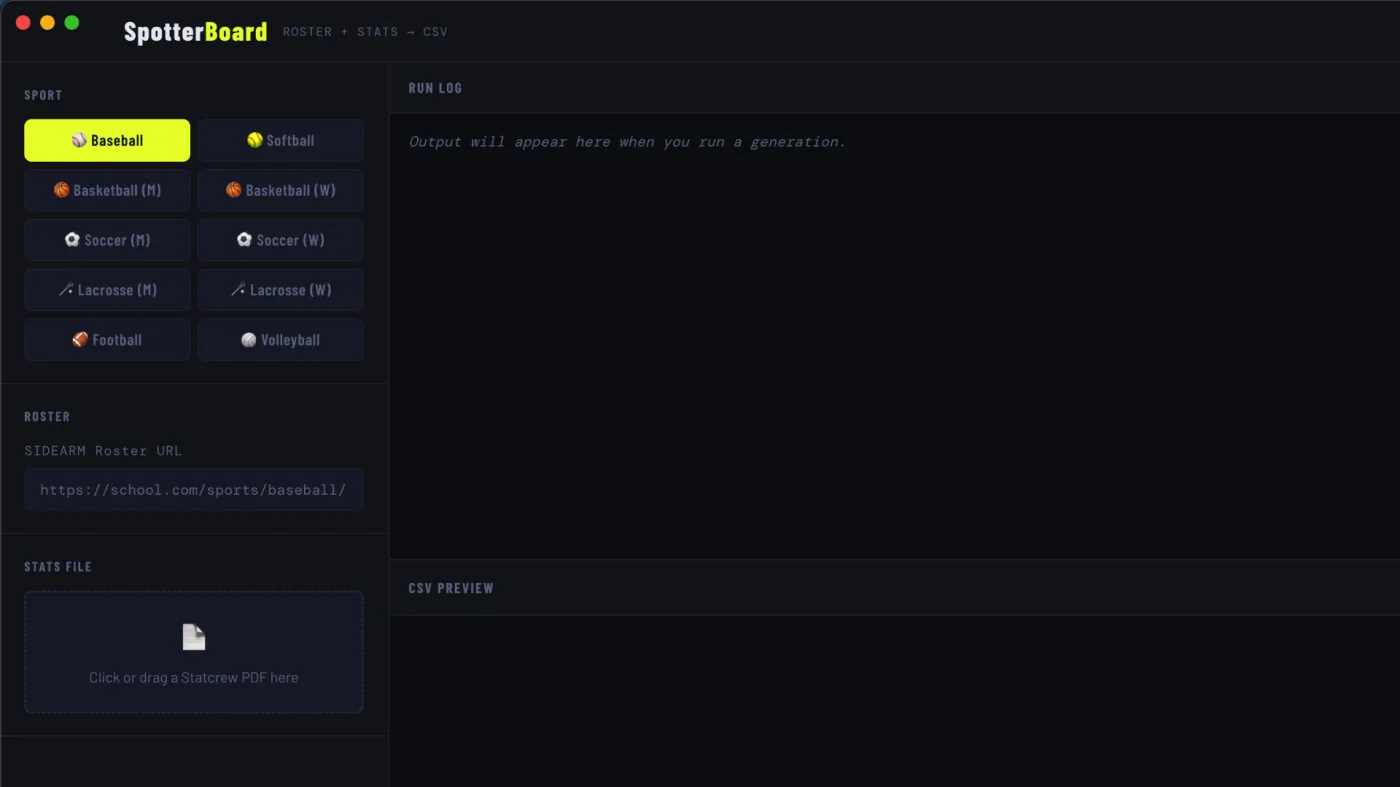
That’s the answer to the question we started with. What have I been up to? I’ve been thinking, and in some cases, building time-saving tools that provide a strategic re-think of these exact processes. How can we use modern, limited resources to create a new paradigm while still fulfilling a multitude of compliance and media obligations?
AI is the easy answer. How you strategically deploy it is the deeper solution.