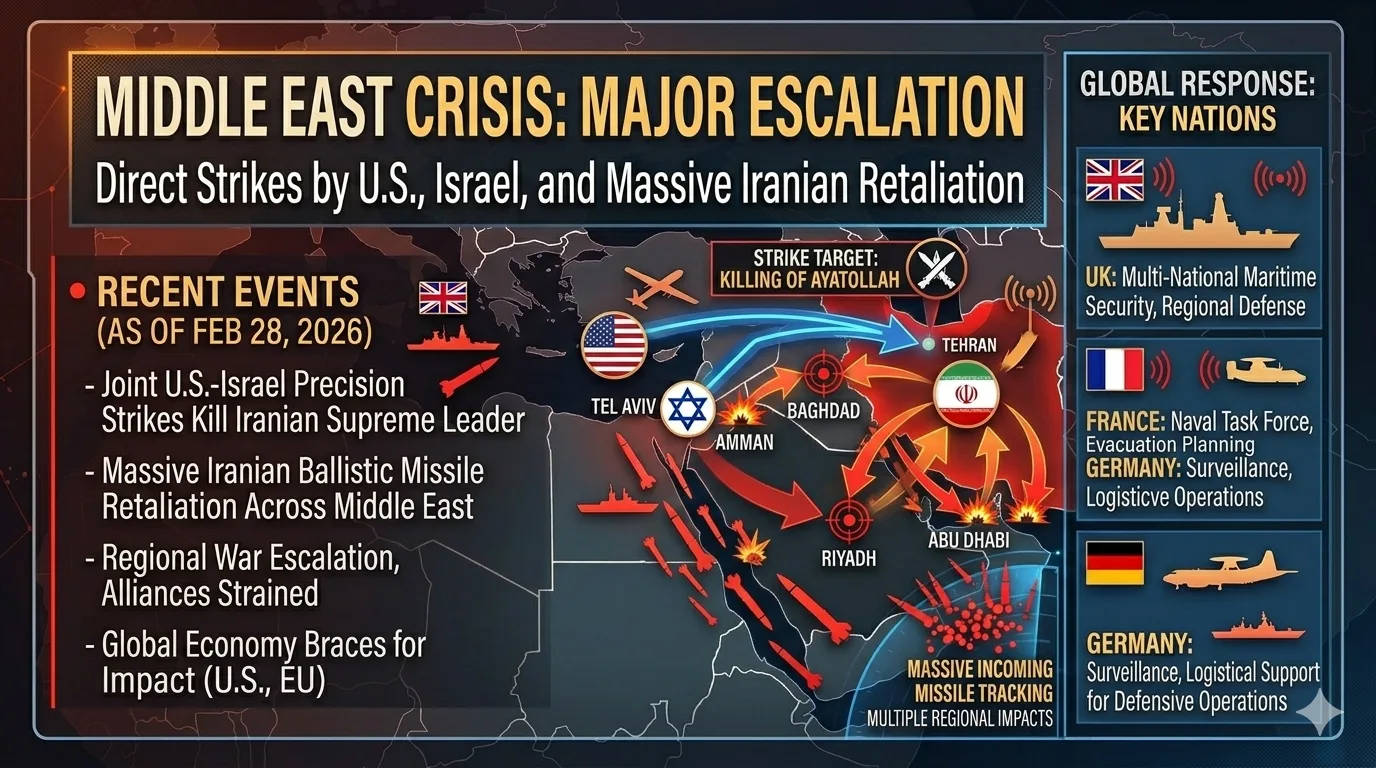
As news broke on Saturday, rumors quickly spread about the demise of the Iranian de facto leader Ayatollah Ali Khamenei. Those rumors were quickly refuted by the Iranians, but later the tone shifted as the Iranian state media confirmed the death of the nation’s Supreme Leader of 36 years.
Along with the Ayatollah, dozens of high-ranking leaders have been assassinated along with former Iranian dictator Mahmoud Ahmadinejad.
The coordinated strikes by the US and Israel were responded to in force by the Iranian. Iran returned fire and struck several countries that host American military bases including United Arab Emirates, Qatar and Bahrain. Damage has been reported at the airport in Dubai, with additional strikes in Kuwait, Iraq, Bahrain, Jordan, Israel and Saudi Arabia.
On top of the targeted strikes on US military structures in the Middle East, the Iranians have also moved to close the Strait of Hormuz through which 20% of the world’s crude oil supply transits.
Sunday brought news that the American home front never wants to see in any type of conflict as the death of three servicemen was announced by US Central Command.
While the conflict appears to be no where near conclusion, the actions of the weekend bode one major question: What’s next?
Monitor the Markets
The crude oil markets open at 6:30 PM ET in the United States on Sunday evening. Early indications project a $2/barrel bump to $70/barrel. As recently as early January, West Texas Intermediate (WTI) crude was trading at $55/barrel. There are other projections of $100/barrel oil which hasn’t been seen since July 4th weekend in 2022.
Iran has not moved to technically close the Strait of Hormuz, despite maritime radar systems showing masses of shipping vessels piled up waiting to enter the 35-mile strait which leads to the Persian Gulf.
If the technical move is made to close the Strait of Hormuz, the $100/barrel suggestion isn’t out of the realm of possibility until the supply chain recovers globally. However, closing the Strait would also effect oil shipments to China and Russia, which could be behind the scene pulling the strings to ensure the Iranian navy does not cut them off from much-needed oil supplies.
Timelines
The next question is: How long will this conflict will last. The last designed incursion into Iran last 12 days when Israel and the United States targeted Iranian nuclear infrastructure in June 2025.
That situation did not include nearly as large of a build-up of US military might and was mostly an aerial assault with bunker busting bombs. This go-round includes Navy, Marines and Air Force personnel for certain.
More importantly, the limited US involvement also led to no casualties during the the June incursion. So far, three US soldiers have been killed by Iranian strikes. However, the US Homefront has very little appetite for losing the lives of brave, young American service members.
One report in the UK Daily Mail noted that President Trump indicated the ongoing strikes may last for four weeks.
Additional Involvement
On top of the US and Israel, there are other possible entrants into this conflict. France, Germany and the United Kingdom have stated they will protect interests in the region, while the possibility remains that Kuwait, Qatar and even Saudi Arabia may join the fight.
Any nation that has sovereign territory attacked by Iranian missiles may join the fight from a defensive posture.
The overwhelming question also leans into the possibility of involvement from Russia and China. It’s widely believed that both of Iran’s allies have supplied the rogue nation with munitions, including some nuclear infrastructure.
While the possibility remains that Russia and China will not remain silent while their ally is attacked, the stronger possibility is for posturing to take place as both nations are further isolated from the world community by the day.